
KALAMAZOO—May 5, 2026
On View at Gagosian in NYC April 30 – July 2, 2026
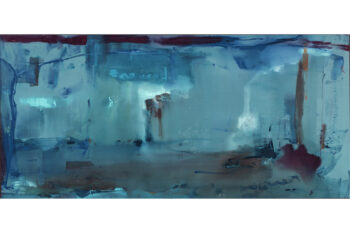
Code Blue, the large-scale Helen Frankenthaler Abstract Expressionist painting from the Kalamazoo Institute of Arts’ permanent collection, was meticulously dismounted, packaged, and shipped this past week to join the exhibition Helen Frankenthaler: The Moment and the Distance at Gagosian in New York City, on April 30, 2026.
This exhibition, organized in collaboration with the Helen Frankenthaler Foundation, surveys four decades of the artist’s paintings from 1960 to 1992, featuring more than twenty of her largest, most ambitious works, arranged by decade.
The iconic Code Blue will return to the KIA following the exhibition’s closing, where it will be reinstalled in October after the conclusion of the exhibition, For the People, By the People: America At 250.
Why This Matters for Kalamazoo
For Kalamazoo, the loan of Code Blue highlights the strength and significance of the KIA’s permanent collection. A painting that has long been part of the local experience will now be seen by thousands of visitors, scholars, and artists in one of the world’s leading art capitals. Loans like this are an essential part of how arts institutions collaborate—placing works in new contexts and expanding public access.
“Code Blue has been a popular painting associated with the KIA’s identity since we acquired it in 1980,” says Rehema Barber, Director of Curatorial Affairs at the KIA. “We’re thrilled to share our incredible painting beyond Kalamazoo for the first time in nearly 30 years, and I’m especially looking forward to the new insights and scholarship this important work will inspire. This is an exciting moment for the KIA, which will spotlight both our collection and our community.”
About Code Blue (1980)
Painted in 1980, the piece’s sweeping fields of blue and immersive scale reflect Helen Frankenthaler’s innovative approach to color and abstraction. Created on the floor of her studio using large brushes, mops, and even buckets, the acrylic painting envelops viewers in washes of blue punctuated by areas of contrast and intensity.
“For many people, Code Blue isn’t just a work in our collection. It’s part of their experience of being here,” said Michelle Hargrave, Executive Director of the Kalamazoo Institute of Arts. “It’s something they’ve stood in front of, returned to, and remembered. This painting came to Kalamazoo through a matching National Endowment for the Arts grant and the vision of donors who believed that great art should live in communities like ours—not just in major cities. Sharing it now expands access, sparks new conversations, and connects our community to a broader cultural world.”
Helen Frankenthaler (1928–2011)
Helen Frankenthaler was one of the most influential American painters of the 20th century and a pivotal figure in the evolution of modern art. In the early 1950s, she developed her groundbreaking “soak-stain” technique, pouring thinned paint directly onto raw canvas so that color became embedded in the surface.
While women and artists of color were working alongside many of the most prominent Abstract Expressionists—who were largely white men—artists like Frankenthaler made significant breakthroughs during the movement’s second generation. Her work helped expand the language of abstraction and opened space for a broader range of voices. A generation of women artists—including Lois Mailou Jones, Mary Abbott (both represented in the KIA’s collection), Grace Hartigan, Nell Blaine, Jane Freilicher, and Elaine de Kooning—gained increased recognition and contributed new energy and perspectives to the field.
Frankenthaler once described her painting as “inner amorphous worlds or depths exploding on the surface and in perspective,” channeling the fluidity of pigment that washes over works Code Blue (1980), punctuated by opaque elements in contrasting colors. “You have to know how to use the accident, how to recognise it, how to control it, and ways to eliminate it so that the whole surface looks felt and born all at once”, Frankenthaler says.
Across a career spanning more than six decades, Frankenthaler created paintings, prints, and works on paper that balance spontaneity and intention, often evoking landscape, atmosphere, and emotion. Her work is held in major museum collections worldwide, including The Museum of Modern Art, the Whitney Museum of American Art, and the National Gallery of Art.
Gagosian
Established by Larry Gagosian in Los Angeles in 1980, Gagosian is a global gallery specializing in modern and contemporary art that employs more than three hundred people at eighteen exhibition spaces across the United States, Europe, and Asia.
With exhibition spaces designed by world-renowned architects such as Caruso St John, Richard Gluckman, Richard Meier, Jean Nouvel, Selldorf Architects, and WHY, Gagosian is able to show a wide range of compelling projects—including work as varied as Jenny Saville’s painterly depictions of the human form, Brice Marden’s lyrical abstractions, Richard Serra’s iconic monumental sculptures and drawings, and a re-creation of Roy Lichtenstein’s site-specific and temporary wall painting Greene Street Mural.
Extended Hours at the KIA on FREE Thursdays
While Code Blue is on view in New York, the KIA continues to offer a vibrant schedule of exhibitions and programs.
Enjoy free general admission and extended hours until 8pm on Thursdays thanks to generous support provided by Art Bridges Foundation’s Access for All program and the Efroymson Family Fund.
Free Thursdays removes barriers and opens doors to inspiration, learning, and connection, whether someone is a lifelong art enthusiast or just wants to explore and reflect.
About the Kalamazoo Institute of Arts
Founded in 1924, the Kalamazoo Institute of Arts (KIA) is a nationally accredited art museum and community art school that brings people together through creativity, learning, and shared experience. Each year, more than 100,000 visitors explore 10–15 rotating exhibitions across the museum’s 10 galleries, drawn from a permanent collection of more than 4,600 works spanning American, European, Asian, and contemporary art.
Beyond the galleries, the KIA is a place where art is not only viewed but made. The Kirk Newman Art School (KNAS) welcomes more than 3,400 enrollments annually, offering hands-on instruction in ceramics, sculpture, jewelry, drawing and painting, printmaking, fiber, photography, glass fusing, and enrichment programs for all ages. Students learn directly from professional artists and educators in a dynamic, studio-based environment.
The museum campus also includes a multi-media auditorium, a publicly accessible art library, an interactive children’s gallery, and the KIA Gallery Shop featuring work by local, regional, and international artists.
Through exhibitions, education, and community partnerships, the KIA serves as a cultural anchor for Southwest Michigan — a place where art sparks curiosity, strengthens connection, and inspires new ways of seeing. Learn more at kiarts.org.